
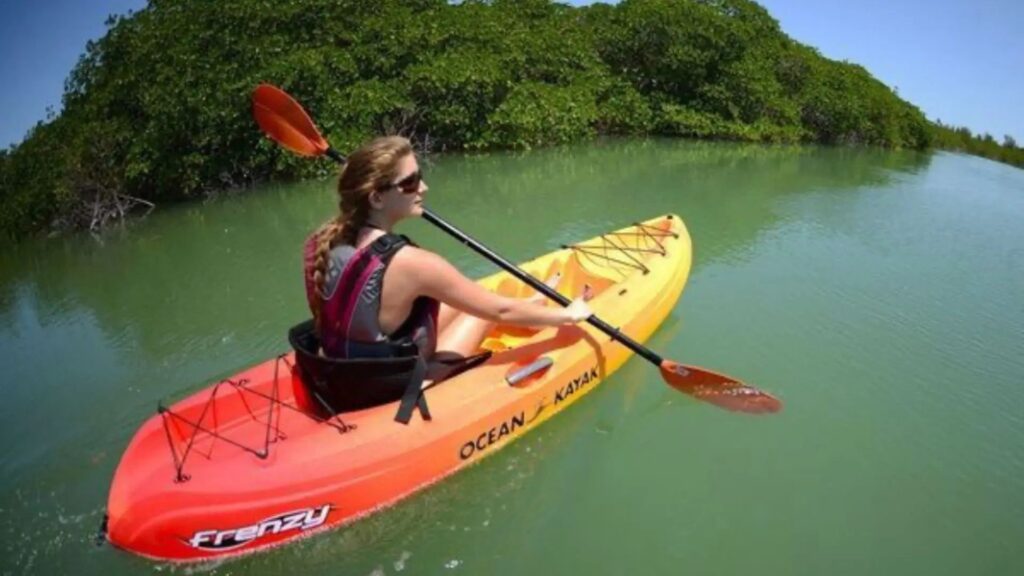
By Justin Lammers, owner of Grab N Go Kayaks and creator of the KayakDIY YouTube channel
Last updated: October 13, 2026
Quick answer: Kayaking for beginners in Cape Coral is easy if you start in a calm canal behind a waterfront home. Rent a stable single or tandem kayak, learn four strokes (forward, sweep, reverse, brake), stay within 1 to 3 miles of your dock on the first outing, and wear your life vest the whole time.
Most first-timers I deliver to have the same two worries. Will I tip, and will I be able to get back? Both are fair. Both get a lot smaller once you realize a Cape Coral canal is closer to a quiet street than to open water.
The canals are long, mostly straight, and lined with seawalls and docks. You can see where you are at all times. That makes them the best classroom in southwest Florida. This guide covers everything I walk new paddlers through when I drop a kayak at a canal home: how to hold the paddle, the four strokes that matter, how far to go, what to do if you flip, and a simple plan for your first outing.
In this guide
- Why you should start in a canal
- Choosing your first kayak
- Before you push off
- How to hold the paddle
- The four basic strokes
- How far can a beginner go?
- What to do if you tip
- A first-outing plan from a canal home
- Where to paddle once you are comfortable
Why you should start in a canal
Open water is where beginners get into trouble. Wind builds, boat traffic gets heavier, and there is nothing to grab if you get tired. A residential canal flips all of that in your favor.
- Protection from wind. Houses, trees and seawalls break up the breeze. Chop is small compared with the Caloosahatchee River or Matlacha Pass.
- A dock within a few strokes. If you are tired, you can rest anywhere.
- Light boat traffic. Keep to the side and watch for wakes.
- Your own launch. You step on from your dock instead of hauling a kayak down a ramp. Read how to get in and out of a kayak from a dock or seawall before your first launch.
Some Cape Coral canals are freshwater and closed off by weirs. Others are saltwater and lead to the Caloosahatchee River. Our Cape Coral canals guide explains which one you are on. Either works for day one. Just do not try to reach the river yet.
Choosing your first kayak
For a beginner, the best kayak is the one you feel steady in. Wide and stable beats fast. If you want the full breakdown, our pillar guide on which kayak to rent in Cape Coral compares every option. Here is the short version for first-timers.
| Kayak | Best for a first-timer who… | 1 day price |
|---|---|---|
| Single kayak | wants to learn the strokes alone and go at their own pace | $45 |
| Tandem kayak | is nervous and wants a partner, or is paddling with a child or friend | $60 |
| Single pedal kayak (Old Town Ocean Kayak Malibu PDL) | wants hands free and to steer with a rudder instead of a paddle | $100 |
| Fishing kayak | plans to fish from the first day | $60 |
You will see “sit-on-top kayak for beginners” in a lot of searches, and for good reason. A sit-on-top kayak has no enclosed cockpit. You sit on the deck, not inside it. If you tip, you are not trapped. You climb back on. Our Malibu PDL pedal kayak is a sit-on-top design. For the single, tandem and fishing models, text us and we will tell you the exact seat style before you book.
Pedal kayaks suit anxious first-timers who want both hands free. You pedal, steer with a rudder, and the Malibu PDL weighs about 105 lb, so it is a boat you want delivered to your dock. A basic single teaches you the strokes for $45 a day. See the 2026 cost guide for every price.
Each rental includes a paddle, life vest, dry bag and safety whistle. Individual paddlers are generally 250 lb or less, and capacity varies by kayak, so tell us your size when you book.
Before you push off
Five minutes of checking saves a lot of trouble. Do this at the dock, not on the water.
- Put on your life vest and buckle it. Sitting on the deck beside you does not count. Florida law requires a wearable life jacket for each person aboard, and children under six must wear one on vessels under 26 feet, according to the Florida Fish and Wildlife Conservation Commission. Our Florida kayak laws guide covers the rest.
- Clip the whistle to the vest. It is a safety whistle. It should be where you can reach it without digging.
- Check the sky and the wind. Pull up the National Weather Service Tampa Bay forecast for your area. Skip the outing if you hear thunder or see a storm building to the east. Summer afternoon storms in southwest Florida arrive fast. Our wind, tides and weather guide explains the patterns.
- Put your phone in the dry bag. Add sunscreen, water, and a hat. Keep the dry bag clipped or tucked under the bungee.
- Tell someone your route. A text to someone inside the house is enough.
How to hold the paddle (the right way up)
This is the number one thing I fix on delivery day. Most beginners hold the paddle backward, upside down, or too close together. Two checks:
- Concave side toward you. The blade has a scooped face and a rounded back. The scooped face is the “power face” and should face you as you pull back.
- Hands wider than your shoulders. Rest the paddle on top of your head and slide your hands out until your elbows make a right angle. That is your grip.
Keep a loose grip. Squeezing the shaft tires your forearms in ten minutes. Not sure you have it right? Text us a photo and we will tell you.
The four basic strokes
You do not need a lesson series. For a first outing, four strokes cover almost everything. These are the “kayak tips for beginners” that actually matter, and they are the same ones I use when I am rigging and testing a boat on the canal behind my house.
1. Forward stroke
This is the one you will use most. Reach forward, plant the blade near your feet, and pull your body past it. Think of it as rotating your torso, not tugging with your arms. Your top hand stays at about eye height. Lift the blade out when it reaches your hip, then switch sides.
Common mistake: a long, deep stroke that sweeps behind your hip. That turns the boat. Keep it short and near the kayak.
2. Sweep stroke (turning)
To turn right, take a wide arc on the left side. Plant the blade near your toes and sweep it in a big half circle to the back of the kayak. The kayak will swing away from the side you are paddling on. Two or three sweeps will turn most boats around in a canal.
3. Reverse stroke (backing up)
Rotate your torso and place the blade near your hip. Push it forward and down toward your feet. Use it to back away from a seawall or to line up with your dock before you get out.
4. Brake (stop)
Plant both blades in the water at your sides and hold them firm, or do a few reverse strokes. A boat wake is coming? A manatee surfaces ahead? Brake, point the bow into the wake, and wait.
For a tandem kayak, the front paddler sets the pace and the back paddler matches it. If you are the partner in the stern, you steer. Our post on tandem kayaking in Cape Coral goes into the details.
Skip the roof rack. Learn on your own dock.
We deliver a kayak, paddle, life vest, dry bag and whistle to your Cape Coral or Fort Myers dock, and we pick it up when you are done. Single kayaks start at $45 for the day.
How far can a beginner go?
On your first outing, plan for 1 to 3 miles total, out and back. Most beginners paddle around 2 miles an hour in calm water, so that is roughly 30 minutes to an hour and a half on the water, including breaks. That is plenty. Your shoulders and your lower back will tell you if you try to do more.
| Experience | Suggested distance (round trip) | Where |
|---|---|---|
| Never paddled before | About 1 mile | Your own canal, within sight of your dock |
| Comfortable after an hour | 2 to 3 miles | Out your canal to the first big intersection and back |
| Day two or three | 3 to 5 miles | Longer canal loops, or drive to a launch with safe transport |
Direction matters too. Paddle into the wind or current on the way out, so the trip home is easier. Tides move through saltwater canals, and you can check them on NOAA Tides and Currents. The 3 to 7 day tier is one flat price, so weekly kayak rentals let you go a little farther each morning at no extra cost.
What to do if you tip
It does not happen often in a canal. But if it does, it is a non-event if you know the steps.
- Stay calm and hold on. Your vest keeps you afloat. Keep one hand on the kayak or paddle.
- Flip the kayak right side up if it is upside down. Grab the far edge and pull it toward you.
- Swim to the nearest dock ladder or low spot on the seawall. Seawalls are tall and hard to climb. Know where your dock ladder or steps are before you launch.
- Re-enter a sit-on-top from the side. Kick your legs up behind you, push your chest across the deck, and roll to a seated position. Do this next to the dock, not in the middle of the canal.
- Empty the kayak, collect your gear, and decide. If your phone was in the dry bag, you are fine. If you are shaken, call it a day.
If you cannot get back on, hold the kayak and swim it to the dock. Blow the whistle if you need help. Practice getting back on once, close to the dock, in the first twenty minutes. A planned swim in warm water takes the fear out of the real thing. Our Cape Coral kayak safety guide has the full checklist.
A first-outing plan from a canal home
Here is the schedule I give guests when I drop a kayak at a canal home in southwest Cape or near Cape Harbour. Adjust it to your pace.
| Time | What to do |
|---|---|
| 0:00 to 0:10 | Check the forecast, put on your vest and whistle, load the dry bag. |
| 0:10 to 0:25 | Get in at the dock and practice the four strokes right beside it. Do a sweep turn in each direction. Try a brake. |
| 0:25 to 0:35 | Practice re-entry once if you are willing. It is optional but worth it. |
| 0:35 to 1:15 | Paddle your canal into the wind for about half a mile, stay on one side, and look for birds on the docks. |
| 1:15 to 1:25 | Turn around with a wide sweep, take a drink, and check the sky. |
| 1:25 to 2:00 | Paddle home with the wind behind you. Back into the dock with reverse strokes. |
Keep your eyes open on the way. Brown pelicans and ospreys use dock pilings, and snook can sit under shaded docks in warm months. In saltwater canals, a West Indian manatee may roll past. Stay back and let it pass. Our guides to Cape Coral wildlife from a kayak and where to see manatees explain how to give them space.
Where to paddle once you are comfortable
After your canal outing, you can move your delivered kayak to another launch if you can transport it safely on a roof rack or in a truck. We do not deliver to public parks or boat ramps, because the City of Cape Coral and Lee County asked rental companies to keep operations off park property. A park is a place you drive to yourself.
The City of Cape Coral lists public kayak launches on its kayaking page, including Four Mile Cove Ecological Preserve and Yacht Club Boat Ramp. Our best places to kayak in Cape Coral ranks them. We also cover Fort Myers kayak rentals, and the booking guide walks through the request form, delivery and pickup.
Frequently asked questions
Is kayaking hard for a first-timer?
No. Most people feel steady within ten minutes in a calm canal. The learning curve is mostly about holding the paddle correctly and keeping your strokes short. A wide, stable single or tandem kayak makes it easier. Start near your dock, and you can stop any time.
What is the best kayak for beginners?
A stable, wide sit-on-top kayak. It is easy to get back on if you tip and has no enclosed cockpit. A single kayak is the simplest choice at $45 for a day. A tandem kayak works well if you want company. Text us if you are unsure.
How do you paddle a kayak correctly?
Hold the paddle with the scooped face toward you, hands wider than your shoulders. Reach forward, plant the blade near your feet, and rotate your torso as you pull the blade to your hip. Switch sides. Keep strokes short and close to the boat.
How far should a beginner paddle on the first day?
Plan for 1 to 3 miles round trip, which is about 30 minutes to an hour and a half. Paddle into the wind on the way out so the trip home is easier. If you are tired at the halfway point, turn around.
What should I do if my kayak flips?
Stay calm, hold the kayak, and swim it to your dock ladder or steps. Your life vest keeps you afloat. Flip the kayak upright, kick your legs up, and climb back on over the side. Practice once next to the dock before you go farther.
Can I kayak in Cape Coral without a boat ramp or roof rack?
Yes. That is what we do. We deliver the kayak to your waterfront home, vacation rental with a private dock or seawall, or a condo with suitable secure storage. You launch from your own dock, and we pick it up when you are done.
Is it safe to kayak in Cape Coral canals?
Canals are one of the calmer places to paddle in the area, but nothing is risk free. Wear your vest, watch for boat wakes, check the forecast, and avoid thunderstorms. Our Cape Coral kayak safety guide covers the details, including alligators in freshwater canals.
How much does it cost to rent a kayak in Cape Coral?
Our single kayaks are $45 for one day, $80 for two days, and $120 for 3 to 7 days. Tandem kayaks are $60, $100 and $180. Prices include taxes, and a cash discount is available. Delivery is free throughout Cape Coral and to most Fort Myers addresses.
Your first paddle starts at your own dock
Tell us your dates, your address and who is paddling, and we will help you pick the right kayak. Delivery is free in Cape Coral and most of Fort Myers, pickup is included, and single kayaks start at $45 a day.
Call (605) 760-4448 · Text us · Request your rental online
Ready to pick a boat? See our single kayak rentals or browse every kayak.