
Last updated: October 13, 2026
Quick answer: From a kayak in Cape Coral you can realistically see bottlenose dolphins, manatees, ospreys, brown pelicans, great blue herons, ibis, anhinga and jumping mullet, with roseate spoonbills and wood storks in shallow flats nearby. Keep 50 yards from dolphins (NOAA), never feed wildlife, and paddle early or late when the water is calm.
The first time a dolphin surfaced beside my kayak, it was close enough that I heard the breath before I saw the fin. That is a normal morning on the water here. Cape Coral sits where the Caloosahatchee River meets the Gulf side of southwest Florida, with about 400 miles of canals running through town, and almost every one of them is a wildlife corridor.
You do not need a boat or a guided tour. Kayaks are quiet, low and slow, which is exactly what wildlife tolerates best. This guide covers what you will actually see, where and when to look, how far to stay back, and how to get a decent photo from a boat that is moving under you.
In this guide
- Bottlenose dolphins
- Manatees
- The birds you will see
- Mullet, crabs and iguanas
- Burrowing owls (the land bonus)
- Viewing ethics and distances
- Photo tips from a kayak
- Frequently asked questions
Wildlife at a glance
| Animal | Best places to look | Best time | How to spot it |
|---|---|---|---|
| Bottlenose dolphin | Caloosahatchee River, Matlacha Pass, San Carlos Bay, Gulf access canals near open water | Year-round; early morning and slack water are calmest | Watch for a dark back rolling, birds diving, and fish scattering |
| West Indian manatee | Warm-water spots, canals, river edges | Cooler months are the most reliable | Look for flat “footprint” swirls and snouts breaking the surface |
| Osprey | Channel markers, dock pilings, utility poles | Year-round | Hovering, then a feet-first plunge for fish |
| Bald eagle | Tall pines near open water | Nesting season runs October 1 through May 15 | Large dark bird with a white head, often at a big stick nest |
| Brown pelican | Mangrove roosts, pilings, open bays | Year-round | Slow glide low over water, then a head-first dive |
| Great blue heron | Seawalls, mangrove edges, shallow flats | Year-round | A tall gray statue standing still at the water line |
| Roseate spoonbill | Tidal flats and shallow backwaters | Low and falling tide | Pink bird sweeping its bill side to side in mud |
| Anhinga, white ibis, wood stork | Quiet canals, mangroves, mud flats | Year-round; watch the tide | Anhinga drying its wings; ibis probing mud; stork wading with a heavy bill |
Bottlenose dolphins in Cape Coral
If you searched for dolphins in Cape Coral, here is the honest version. They are common in the bigger water around us and they do sometimes work the Gulf access canals, but they are wild animals on their own schedule. Nobody can promise you one. You can stack the odds.
The best odds come from open, moving water. The Caloosahatchee River near the Cape Coral Bridge and the Midpoint Memorial Bridge is a travel lane for fish, and where fish go, dolphins follow. Matlacha Pass, a braided tidal corridor between Pine Island and the mainland, is another strong bet. Paddling Magazine describes bottlenose dolphins herding fish in the shallows there. San Carlos Bay near the Sanibel Causeway is also productive.
Mini fact line: Matlacha Pass. Between Pine Island and the mainland, part of the Matlacha Pass Aquatic Preserve (roughly 14,000 acres of seagrass, oyster bars and mangrove islands per Paddling Magazine). Best for: dolphins, ospreys, pelicans. Open water, so check wind first. If you drive your delivered kayak there yourself, a roof rack or truck is required. We do not deliver to public parks or ramps. More in our Matlacha and Pine Island kayaking guide and on the Matlacha kayak rental page.
How to find them
- Follow the birds. Pelicans and terns diving in one spot usually mean baitfish, and baitfish mean dolphins.
- Look for a rolling back, not a splash. A dolphin’s dorsal fin and back arc up and slide under. Splashing is usually mullet.
- Go early. Wind builds through the day. Calm water shows a surfacing animal from a long way off.
- Stop paddling and listen. The exhale carries across flat water.
If a dolphin approaches you, keep your paddle quiet, keep your hands in the boat and let it go where it wants. Do not reach for it, and never throw it a fish.
Manatees, briefly
Manatees are the other big mammal you may share the water with, and in the cooler months they gather in warm spots around Fort Myers and the Caloosahatchee. They deserve their own page, so we wrote one: where to see manatees in Cape Coral and Fort Myers and how to paddle near them. The short version is to give them room, watch for slow-speed zones, and never touch them.
The birds of Cape Coral you will see from a kayak
Osprey
Ospreys are the easiest bird to find. Look at the channel markers, dock pilings and utility poles along the river and in the canals. They hover, fold up and hit the water feet first. If you see one carrying a fish headfirst into the wind, you just watched a successful dive.
Bald eagle
Florida has the densest bald eagle population of any state outside Alaska, according to FWC. The official nesting season starts October 1 and, per the Sanibel-Captiva Conservation Foundation, runs through May 15. Eagles nest in tall trees, and the federal guideline is to avoid disturbing an active nest within 660 feet. If you spot a huge stick nest high in a pine, stay on the water and keep your distance. Eagles are a lucky sighting here, not a promise.
Brown pelican
Brown pelicans roost in the mangroves and on pilings, and they give you an easy lesson in fishing: a slow glide a few feet above the water, then a crash dive. In the canals, they often sit on docks like they own the place.
Great blue heron
The great blue heron is the tall gray bird standing motionless on a seawall or at the edge of a mangrove. Paddle in at an angle, not straight at it, and you can often drift close enough for a clean photo before it lifts off with a croak.
Roseate spoonbill
The pink bird that gets mistaken for a flamingo is the roseate spoonbill. It sweeps its flat bill side to side through soft mud on tidal flats. The J.N. “Ding” Darling National Wildlife Refuge on Sanibel is a well-known place to find them, and they are reported there year-round. Around Cape Coral your best bet is shallow, muddy backwaters on a falling tide, especially in Matlacha Pass and the flats around San Carlos Bay. Stay well back. Spoonbills spook easily and a flushed flock is a wasted morning.
Anhinga, white ibis and wood stork
Anhingas swim with just their snake-like necks above the surface, then perch with wings spread to dry. White ibis probe wet grass and mud with curved orange bills. Wood storks wade through the shallows with heavy bills held open. All three like quiet canal edges, mangrove shores and mud flats, and all three are more active when the tide is moving.
Skip the roof rack and paddle from your own dock
We deliver kayaks to your Cape Coral or Fort Myers waterfront for free, with paddles, life vests, a dry bag and a safety whistle included. Rentals start at $45 a day, and pickup is included.
Mullet, mangrove crabs and iguanas
Jumping mullet. Striped mullet are the fish that launch themselves out of the water and slap back down, sometimes in streaks across a canal. Nobody has a settled answer for why. They can land in your lap, and it startles people every time. Treat it as a sign that the canal is healthy and full of life.
Mangrove crabs. Look into the roots along mangrove shorelines, especially at low tide, and you will often see small crabs scuttling on the trunk and roots. Watch from the water. Do not pull yourself in by grabbing the roots, since the mangroves are protected habitat.
Green iguanas. Iguanas are not native to Florida, but you will see them sunning on seawalls and dock caps. The City of Cape Coral notes that iguanas are herbivores and that the city does not trap them. Nile monitors are a different matter, and the city runs a trapping program for those. If you cannot tell the two apart, the City of Cape Coral publishes an identification guide on its environmental FAQ page.
Bonus: burrowing owls, Cape Coral’s city bird
You will not see these from a kayak. Burrowing owls live on dry, open ground, so they are a bonus for the hour you spend on land. Cape Coral adopted the Florida burrowing owl as its official city bird on September 6, 2005, and the city says there are more than 3,500 burrows. Look in open lots, parks and ballfields for a small owl standing near a burrow entrance. The Calusa Blueway notes that nesting season runs from February to mid-July, and that some burrows sit at the Pelican Baseball Complex.
Burrowing owls are protected. The city says that harassing or killing owls, or damaging their burrows, is a crime. Keep your distance, stay out of the burrow area, and keep dogs back. Report violations to the FWC 24-hour hotline at 1-888-404-3922. For injured owls, call CROW at 239-472-3644.
Viewing ethics and the distance rules
The Marine Mammal Protection Act is the law behind the distance guidance, and NOAA Fisheries is the agency that spells it out for the public.
- Dolphins: stay at least 50 yards away when viewing from a watercraft. NOAA notes some locations require 100 yards, so check local rules.
- Kayaks count. NOAA says kayaks, paddleboards and jet skis should keep the same distances as larger boats.
- Never feed marine mammals. NOAA says feeding is harmful and illegal.
- Do not chase, encircle or trap animals. If they show signs of disturbance, slowly leave.
- Birds: if a bird flies off or a flock starts shifting, you are too close. Back off.
- Nests: if you see a nest, go around. Eagles need a 660-foot buffer.
A dolphin that chooses to approach your boat is a different situation from you chasing one. Stop paddling and let it pass. Our Florida kayak laws and rules guide covers manatee zones and the rest of the boating rules.
Photo tips from a kayak
- Bring a dry bag, a lanyard or a floating strap. Your rental includes a dry bag, but a phone on a lanyard saves a lot of grief.
- Shoot at the longest zoom you have and stay put. Do not drift toward the animal to get a tighter frame. Crop later.
- Wait for the drift to settle. Hold the paddle across your lap or tuck it under a deck bungee. Water-bounce blurs more shots than shaky hands do.
- Use the light. Early morning and late afternoon give you soft side light and calmer water. Sunrise and sunset paddles are worth planning: see our sunset and sunrise kayaking guide.
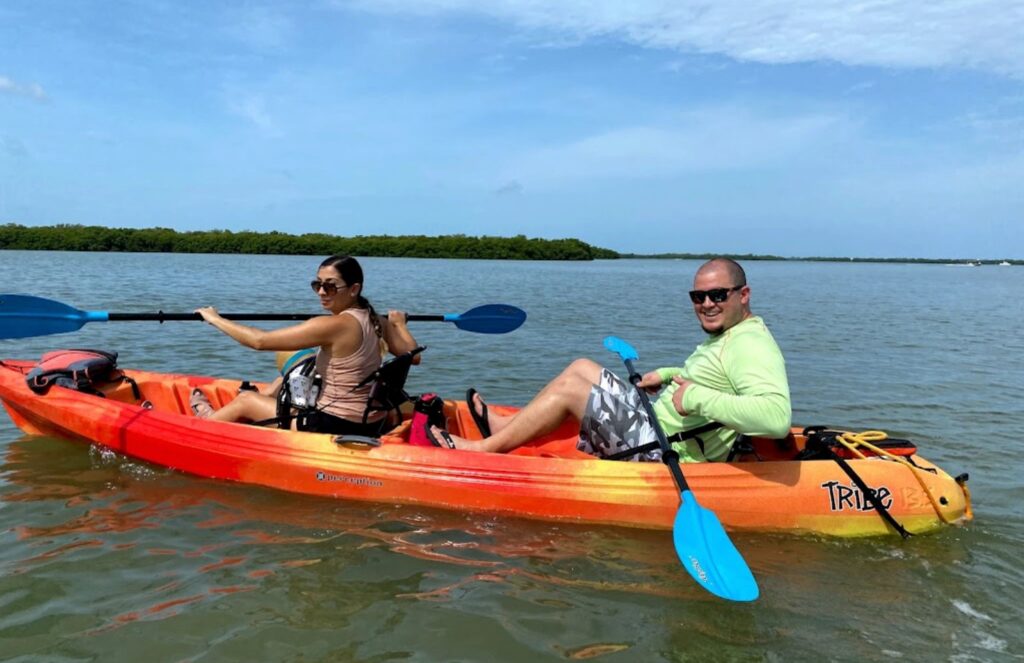
- Pick the right kayak. A tandem kayak lets one person paddle while the other shoots. If you want to float quietly and photograph hands-free, a single kayak is lighter and quieter.
Where to start with a delivered kayak
The simplest way to see wildlife here is to launch from your own dock and paddle the water you already have. A canal edge with mangroves, docks and a few pilings holds more birds than many people expect. If your canal opens to the river or a wider channel, you may see dolphins and manatees too. Our Cape Coral canals guide explains which canals reach the Gulf and which do not.
If you are staying in Fort Myers, see our Fort Myers kayak rentals page. For a bigger list of destinations, our pillar guide to the best places to kayak in Cape Coral is the place to go, and the Four Mile Cove Ecological Preserve guide covers a local mangrove paddle. For seasons and weather, read the best time to kayak in Cape Coral.
Not sure which boat suits your plans? Our guide to choosing a kayak compares singles, tandems, pedal and fishing models.
Frequently asked questions
Can you see dolphins from a kayak in Cape Coral?
Yes, sometimes. Bottlenose dolphins live in the Caloosahatchee River, Matlacha Pass and San Carlos Bay, and they occasionally come into Gulf access canals. They are wild, so sightings are never guaranteed. Early mornings, calm water and diving birds give you the best chance.
How close can you get to a dolphin in a kayak?
NOAA says to stay at least 50 yards from dolphins when viewing from any watercraft, including kayaks. Some places require 100 yards. If a dolphin approaches you on its own, stop paddling, stay calm and let it pass. Never feed or touch one.
What is the best time of day to see wildlife from a kayak?
Early morning. Wind is usually lighter, the water is flatter and birds are feeding. Late afternoon works too. Midday brings more boat traffic, more wind and more heat, and animals tend to hide or move off.
Where can I see roseate spoonbills near Cape Coral?
The J.N. “Ding” Darling National Wildlife Refuge on Sanibel is a well-known place to find them. Around Cape Coral, look in shallow muddy backwaters and tidal flats, especially around Matlacha Pass and San Carlos Bay, on a low or falling tide. Keep your distance so they keep feeding.
Is Cape Coral’s city bird the burrowing owl?
Yes. Cape Coral adopted the Florida burrowing owl as its official city bird on September 6, 2005. The owls live on land in open areas, not on the water. They are protected, and harassing them or damaging their burrows is a crime.
Are there bald eagles in Cape Coral?
Florida has a dense bald eagle population, and southwest Florida has nesting pairs. The official nesting season runs October 1 through May 15. Look for large stick nests in tall trees near water, and keep at least 660 feet from an active nest.
Are iguanas dangerous?
Not really. Green iguanas are plant eaters, and the City of Cape Coral says it does not trap them. They are not native, and they can bite or scratch if cornered, so just leave them alone. Nile monitors are a separate invasive lizard that the city does trap.
Do I need a guide to see wildlife by kayak?
No. Plenty of wildlife lives right along your own canal and the bigger waterways nearby. We do not run guided tours. We deliver kayaks to your Cape Coral or Fort Myers waterfront, and you paddle on your own schedule. Check wind and tides first.
Is it legal to feed dolphins, pelicans or other wildlife?
Feeding marine mammals is illegal under federal law, according to NOAA. Feeding other wildlife is discouraged. The City of Cape Coral says fed animals lose their fear of people and human food is unhealthy for wildlife. If you fish, do not toss scraps to pelicans.
What should I do if I see an injured or tangled animal?
Do not try to handle it. Note the location and call the right group. For injured wildlife in Lee County, CROW takes calls at 239-472-3644. FWC has a wildlife alert hotline at 1-888-404-3922 for violations. Fishing line and hooks are a common hazard, so pack out your line.
Your canal is already a wildlife corridor
We deliver a kayak to your dock or seawall, with paddles, life vests, a dry bag and a safety whistle, and we pick it up when you are done. Delivery is free throughout Cape Coral and to most Fort Myers addresses, and prices start at $45 a day. Text us your dates and address and we will confirm the right boat.
Call (605) 760-4448 · Text us · Request your rental online
Start with a tandem kayak if you want a spotter, or see our 2026 kayak rental price guide.
Sources: NOAA Fisheries marine life viewing guidelines · City of Cape Coral burrowing owls · FWC bald eagle profile · Sanibel-Captiva Conservation Foundation on eagle nesting season