
Last updated: October 13, 2026
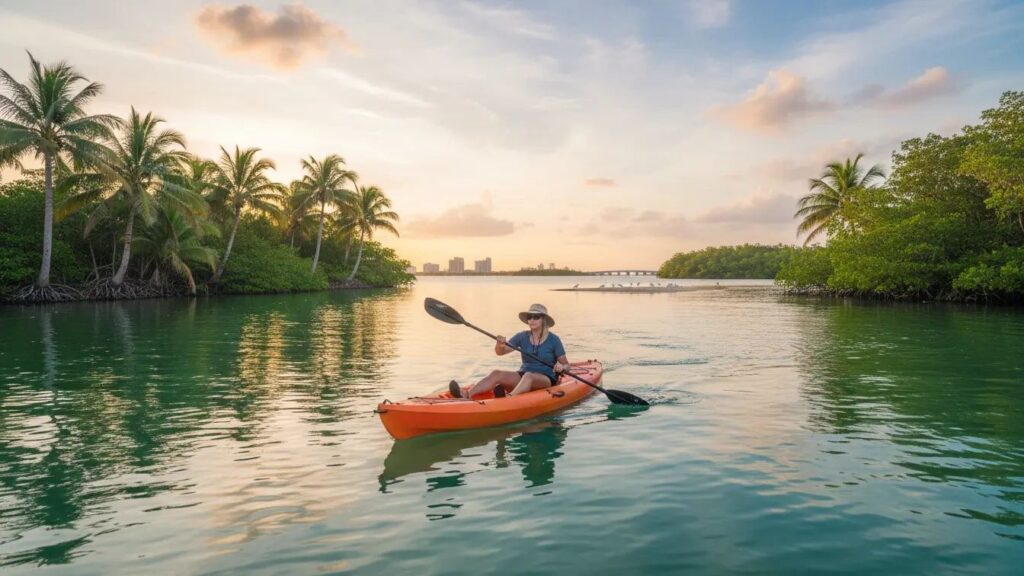
Quick answer: Sunset is the best time to kayak in Cape Coral, and the easiest way is from your own dock. Launch 45 to 60 minutes before sunset from a canal with open sky to the west, carry a white light, wear your vest, and be back before full dark.
Today, October 13, the sun sets in this part of southwest Florida at about 7:01 p.m., and golden hour starts around 6:30. By the last day of October, sunset slips to about 6:45. That is a short window, and it is why people who plan a sunset paddle for 7 p.m. in late fall end up fumbling for a flashlight.
I live on a Cape Coral canal and I have watched a lot of sunsets from a kayak. The canal behind a house is the best seat for it: the water is flat, the dock is your safety net, and nobody is waiting behind you at a ramp. This guide covers how to find a west-facing view, when the sun sets by season, what Florida requires for lights after dark, how to handle the bugs, and what to expect (and not expect) from bioluminescence.
In this guide
- Which canals catch the sunset
- Sunset and sunrise times by season
- Lights and the rules after sunset
- Sunrise paddling
- No-see-ums and mosquitoes
- Bioluminescence: what is realistic
- Safety at dusk
- Paddle at golden hour every day of your stay
- Frequently asked questions
Which canals catch the sunset
Cape Coral’s canal grid is huge, and the direction your canal faces decides what you see. You do not need a map to find out. You need your phone’s compass and ten seconds.
The quick test
- Stand on your dock and look down the canal. Open your phone’s compass.
- Find west. If the canal runs toward west or southwest, you will see the sun set down the length of the water. That is the best case.
- If the canal runs north to south, the sun will set over the houses on one side. You still get color in the sky, but not the sun touching the water. Paddle to the end of the canal or to a cross canal that opens west.
- If the canal runs east, your best light is at sunrise, not sunset (see below).
Satellite view on a map app also works. Look for the long, open stretch of water with no tall trees or buildings in the way.
The sun does not set in the same place all year
In winter the sun sets toward the southwest. In summer it swings well north of west. A canal that frames the sun in December may not frame it in June. If you are staying a week, check the angle on your first evening and adjust the next night.
Places on the water with the widest western sky
- Canals near the river. The southern edge of Cape Coral faces the Caloosahatchee River, which opens up the western horizon. Bimini Basin, the Yacht Club area and Jaycee Park (its lighted riverfront boardwalk reopened April 30, 2026) all look out over the water.
- Southwest Cape. Cape Harbour and Tarpon Point sit near where the river meets San Carlos Bay, and the horizon opens toward the Gulf.
- Wide saltwater canals. Larger saltwater canals leave more sky than narrow ones, and dolphins and wading birds work them at dusk.
- Freshwater lakes and canals. They are calm at dusk and good with kids. Our canals guide explains the difference.
We deliver the kayak to your waterfront address. We do not deliver to parks or ramps, so for the river or any spot away from your dock, you would drive your delivered kayak there yourself, if you can move it safely. For ideas, see the Best Places to Kayak in Cape Coral pillar and the Caloosahatchee River guide. The river at dusk is busier and more exposed, so it is not where I would send a first timer.
Sunset and sunrise times by season
Sunset in this area runs from about 5:30 p.m. in December to about 8:25 p.m. around July 1. The times below are for Fort Myers and North Fort Myers, which are within minutes of Cape Coral. Check the exact time on the day you paddle.
| Date (2026) | Sunrise | Sunset | Planning note |
|---|---|---|---|
| March 8 | 7:44 a.m. (latest of the year) | Check day of | Clocks spring forward, so sunrise is at its latest. |
| June 8 | 6:33 a.m. (earliest of the year) | Check day of | Go at sunrise. Afternoon storms build in summer. |
| June 21 | Early | Late | Longest day of 2026: 13 hours 49 minutes of daylight. |
| July 1 | Early | 8:25 p.m. (latest of the year) | Light until well after dinner, but heat and bugs peak. |
| October 1 | 7:19 a.m. | 7:14 p.m. | Fall light, easing temperatures. |
| October 13 | 7:25 a.m. | 7:01 p.m. | Golden hour starts around 6:30 p.m. |
| October 31 | 7:36 a.m. | 6:45 p.m. | Daylight saving time ends November 1, so evenings get darker earlier. |
| December 1 | 6:58 a.m. | 5:34 p.m. | Launch by about 4:45 p.m. |
| December 21 | 7:11 a.m. | 5:39 p.m. | Shortest day of 2026: 10 hours 27 minutes of daylight. |
Sources: timeanddate.com for December in Fort Myers, and sunrisesunset.io for the October table and the year’s extremes in North Fort Myers.
When to launch
My rule is to be on the water 45 to 60 minutes before sunset. That gives you a few minutes to settle in, half an hour of golden light, and enough margin to be back at the dock while there is still color in the sky. In December, that means launching around 4:30 or 4:45 p.m., because the sun drops fast and dusk is short in Florida.
Our month-by-month guide shows which seasons suit a sunset paddle best. Short version: winter and early spring are cool and pleasant, and summer brings afternoon thunderstorms, so watch the sky and the radar.
Get a kayak waiting at your dock for golden hour
We deliver single, tandem, fishing and pedal kayaks free to your Cape Coral or Fort Myers dock, with paddles, life vests, a dry bag and a whistle included. Prices start at $45 a day, and pickup is included.
Lights and the rules after sunset
Here is what Florida says about paddling after dark. The FWC’s page for human-powered vessels (canoes, kayaks and paddleboards) requires “one lantern or flashlight shining a white light if operating between sunset and sunrise or when visibility is restricted.” That is the minimum. You can read it on the FWC human-powered vessel page.
The federal navigation rules for small craft say the same thing in nautical language. A vessel under oars may show an all-round white light, or keep an electric torch or lighted lantern with a white light ready at hand, and show it in time to prevent a collision. The key idea is that other boats must see you soon enough to steer away.
What this means in practice
- A white light is required after sunset. A flashlight is the legal minimum. A clip-on or pole-mounted white light visible all the way around is better, because a boat can see you from any angle without you waving a flashlight.
- Use a steady white light for navigation. Florida law restricts flashing lights on vessels except as the navigation rules allow, so keep colored and flashing lights for decoration, if at all.
- Wear your life vest. The FWC requires one wearable vest per person aboard, and children under 6 must wear one. At dusk, wearing it is simply smart.
- Keep the whistle on you. Our rentals include a safety whistle, and sound signals help in low light.
- Bring a charged phone in a dry bag, and tell someone your route and return time.
The same rule covers times when visibility is restricted, such as fog or heavy rain, so carry the light even if you plan to be back before dark. We cover more of the legal side in Florida Kayak Laws: Life Jackets, Lights, Manatee Zones and More.
One honest note: our rentals include paddles, life vests, a dry bag and a safety whistle. A navigation light is not on that list, so bring your own white light, or text us at (605) 760-4448 and we will tell you what we can add.
Night kayaking in Florida: the short version
If you search for “night kayaking Florida rules,” the answer is that you may paddle after dark, but you must show a white light, have a life jacket for each person, and make yourself visible. The easiest way to stay inside the rules is to paddle the canal you launch from, close to your dock, with a light on your kayak and a plan. Skip boat channels and open water at night.
Sunrise paddling
Sunrise kayaking in Florida is underrated. The water is flat, the air is cool, most boats are not out yet, and wildlife is moving. In my experience you see more wading birds, more feeding fish and more manatees early in the morning than at any other time of day.
- Face east. A canal that runs east gives you the sun coming up down the water. If your dock faces another way, paddle to a canal opening that faces east.
- Dress for cooler air. A light layer helps in winter, and you can strip it off by 9 a.m.
- Watch for low visibility. Winter mornings can bring haze or fog over the water. Carry the same white light you would at dusk.
- Summer favors early starts. The earliest sunrise of 2026 is June 8 at 6:33 a.m. Paddle then and be off the water before the heat and the storms.
For a wildlife-focused outing, read Dolphins, Birds and Wildlife You’ll See From a Kayak in Cape Coral.
No-see-ums and mosquitoes
Dawn and dusk are the hours you come for, and they are also when biting insects tend to be out. Summer is the worst season. Winter is much better.
- Repellent. Use an EPA-registered repellent on exposed skin and put it on before you launch.
- Cover up. Long sleeves and light pants help. A thin buff or hat protects your neck.
- Keep moving. No-see-ums are weak fliers, and a breeze keeps them off. Paddling out onto open water helps. Sitting still at the dock does not.
- Avoid still pockets near mangroves. Insects collect where the air is calm.
The Lee County Mosquito Control District says it does not spray for no-see-ums because they do not carry disease in southwest Florida and their larvae live in soil that pesticides cannot reach. Its advice is repellent, long sleeves and pants, and a fan or breeze. For mosquito updates, see the Lee County Mosquito Control District. Our packing list covers the rest of what to bring.
Bioluminescence: what is realistic
People search for “bioluminescence Fort Myers” and expect a glowing canal. I want to be straight with you: it can happen in southwest Florida, but it is not reliable, and you should not book a trip around it.
Here is what we can say. The Sanibel-Captiva Conservation Foundation describes the glow as coming from dinoflagellates, tiny single-celled organisms that light up when the water around them is disturbed. It says displays are relatively rare in local waters, show up in winter months, and are best on a new moon in calm water such as a canal. Its example was a 2021 paddling outing in Sanibel’s East End canals, where each paddle stroke left a bluish trail. You can read it in the SCCF’s “Nature’s light show on Sanibel”.
The well-known Florida displays are on the east coast, in the Indian River Lagoon and Merritt Island area, not here. In Cape Coral, treat any glow as a bonus.
If you want to try
- Pick a new moon night, when the sky is darkest. Check the moon phase before you book.
- Choose calm water, like a canal, away from bright dock lights.
- Keep your legal white light on. You can shield it, but you cannot turn it off. See the lights section above.
- Stay close to your dock. Dark water and dark sky make it hard to judge distance.
- Do not count on it. If there is no glow, enjoy the stars and the quiet.
We do not offer guided night tours or clear-bottom kayaks, and we cannot promise a glow. We can put a kayak at your dock. What happens in the water after that is up to the water.
Safety at dusk
- Thunderstorms. Summer afternoons bring storms. If you hear thunder, get off the water. Check the NWS Tampa Bay marine forecast before you launch.
- Judge distance conservatively. Low light makes everything look closer. Stay near the dock or shoreline.
- Boats. Powerboats are harder to spot in low light and may not see you. Stay out of channels and keep your light visible. See Kayak Safety in Cape Coral.
- Manatees. They are hard to see at dusk. Paddle slowly and quietly, and if you feel a bump or see a swirl, stop and let it pass. Our manatee guide has etiquette tips.
- Alligators. They are a freshwater-canal consideration. Give any gator a wide berth. See Alligators, Sharks and Stingrays in Cape Coral Canals.
- Wind and tide. Evening breezes can shift. Read Wind, Tides and Weather in Cape Coral.
- Get in and out safely. Dock entry is harder in low light. Our dock and seawall guide shows the technique.
Paddle at golden hour every day of your stay
This is where a rental that lives at your dock beats a one-off trip. A one-day rental gets you one sunset, and if it clouds up, that is it. A multi-day rental lets you pick the best evening, repeat a favorite, and add a sunrise.
The 3 to 7 day price is one flat rate. A single kayak is $120 for 3 days and still $120 for 7. Over a full week, that works out to about $17 a day.
| Kayak | 1 day | 2 days | 3 to 7 days |
|---|---|---|---|
| Single kayak | $45 | $80 | $120 |
| Tandem kayak | $60 | $100 | $180 |
| Single pedal kayak (Malibu PDL) | $100 | $200 | $350 |
| Tandem pedal kayak | $200 | $300 | $400 |
A simple five-day plan for a vacation rental guest might look like this:
- Day 1, late afternoon: kayak arrives. Short test loop in daylight.
- Day 2, sunrise: flat water, birds, maybe a manatee.
- Day 3, golden hour: your first sunset paddle, with a white light on the kayak.
- Day 4, free: fishing, a river trip if conditions allow, or rest.
- Day 5, sunset again, from a different canal angle. We pick up at the end of your rental.
Pedal kayaks are popular at sunset because you can drift, photograph and keep your hands free. We explain the differences in Single vs Tandem vs Pedal vs Fishing. If you are in an Airbnb or VRBO, see our vacation rental kayak delivery page and the post on renting kayaks for your Cape Coral Airbnb or VRBO stay. Delivery and pickup times are by arrangement, so text us and we will confirm.
Frequently asked questions
What is the best time to go sunset kayaking in Cape Coral?
Launch 45 to 60 minutes before sunset. That gives you time to settle in and enjoy the golden light, and it leaves margin to get back before dark. Winter sunsets come as early as 5:30 p.m., and summer sunsets run past 8 p.m.
Which Cape Coral canals have the best sunset views?
Canals that run toward the west or southwest give you the sun setting down the water. Canals near the Caloosahatchee River and the southwest tip also have wide western skies. Check your own canal with a phone compass or satellite view.
Do I need a light to kayak at night in Florida?
Yes. The FWC requires one lantern or flashlight showing a white light if you are operating between sunset and sunrise or when visibility is restricted. A clip-on or pole-mounted all-round white light is a better setup than a handheld flashlight.
Is it legal to kayak at night in Florida?
Yes, with a white light and a life jacket for each person aboard. Children under 6 must wear one. Paddle close to your dock or a canal you know, and avoid boat channels and open water after dark.
Can you see bioluminescence in Fort Myers or Cape Coral?
Sometimes, but not reliably. The Sanibel-Captiva Conservation Foundation calls local displays relatively rare, seen in winter on calm, dark new-moon nights. Florida’s best-known displays are on the east coast. Do not book a trip expecting a glow.
Are mosquitoes and no-see-ums bad at sunset?
They can be, especially in summer and near mangroves. Use EPA-registered repellent, wear long sleeves, and keep moving, since a breeze helps. Winter paddles are far less buggy than summer ones.
Is sunrise kayaking in Cape Coral worth it?
Yes. Water is flat, boat traffic is light, and wildlife is active. A canal that faces east gives the best view. The earliest sunrise of 2026 is June 8 at 6:33 a.m., and the latest is March 8 at 7:44 a.m.
Is it safe to kayak at dusk?
It is safe if you plan for it: wear your vest, carry a white light, stay near your dock, watch for storms and tell someone your route. Skip open water and channels at dusk. Reschedule if thunderstorms are in the forecast.
Can I keep a kayak for several days and paddle every evening?
Yes. A 3 to 7 day rental is one flat price, $120 for a single kayak and $180 for a tandem. We deliver to your waterfront rental and pick up at the end. Text us at (605) 760-4448 for availability, especially on weekends.
Do your rentals come with a navigation light?
Our rentals include paddles, life vests, a dry bag and a whistle. A navigation light is not listed, so bring your own white light or text us to ask what we can add. The FWC requires a white light after sunset.
Book a kayak for your next golden hour
Tell us your dates and the dock address, and we will deliver a kayak to your Cape Coral or Fort Myers waterfront rental. A 3 to 7 day rental is one flat price, so you can paddle every sunset and sunrise of your stay. Pickup is included.
Call (605) 760-4448 · Text us · Request your rental online
See all options on our weekly kayak rentals page.